
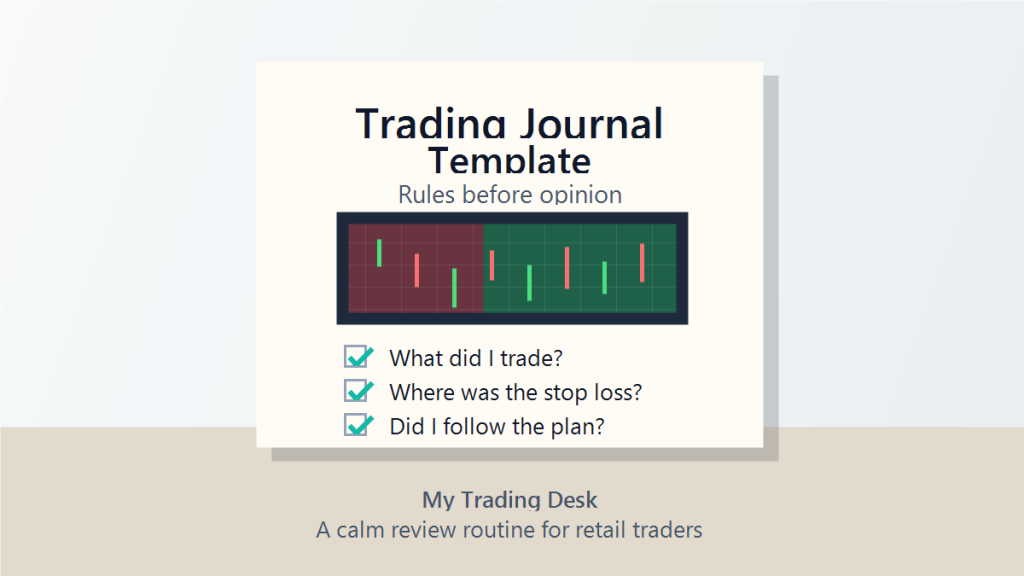
 Journal Note
My Simple Trading Journal Template
My trading journal template is simple because I actually want to use it after the market closes. What I did here was write the page I would fill after an F&O session, when the trade is done and the excuses start coming.
I do not want fifty boxes. I do not want a perfect spreadsheet that looks good but stays empty. I want a trading log that tells me what I traded, why I took it, where the stop loss was, where the target was, and whether I followed the plan.
- Topic: A simple trading journal template for retail traders
- Best for: F&O, futures and options, call, put, long and short trade reviews
- Main rule: Write the risk before writing the opinion
- Best next step: Use the free checklist, then read The Rule Is The Edge if you want deeper rule work
Why This Matters
Most traders do not lose control because they lack opinions. They usually have too many opinions. After a loss, the mind starts rewriting the story. After a win, the mind starts making the trader feel smarter than the rules.
That is why I like a plain journal. It does not care how I feel. It asks the same questions every day. Did I go long or short? Was it a call or put? Did I plan the stop loss before entry? Was the target clear? Did I trail the stop? Did I move to breakeven too early? Did I follow the rule or did I react?
This is not about making trading look professional. It is about making the review honest.
The Problem Traders Miss
A lot of retail traders remember the pain of a bad trade but forget the rule check. They remember that the stop loss hit. They forget whether the stop loss was planned properly. They remember that the market reversed. They forget whether the entry was late.
That is where the journal helps. It slows the review down. It forces the trader to separate result from behaviour. A good trade can lose. A poor trade can make money. The journal should show the difference.
If the move stopped working or never really got going, I want the page to say that clearly. I do not need drama. I need a clean note that says: the idea did not work, the stop loss was respected, and the next trade should still follow the rules.
My Trading Journal Template
This is the simple structure I would use. It is not a signal sheet. It is not a secret strategy sheet. It does not expose private setup rules. It is only a review page.
- Date: The session being reviewed
- Market: Index, stock, futures, options, or another traded market
- Instrument: Call, put, futures contract, or other product
- Direction: Long, short, gone long, or gone short
- Reason: A short note that says why the setup qualified
- Stop loss: Planned before entry
- Target: Planned before entry or clearly marked as not used
- Management: Trailing, breakeven, partial exit, or no change
- Exit: Stop loss, target, manual exit, breakeven, or time exit
- Lesson: One sentence only
That is enough for most days. If I cannot fill this page, I probably did not understand the trade properly.
The Review Checklist
After the trade, I would not start with profit or loss. I would start with the checklist. It keeps the review clean.
- Was the trade planned before entry?
- Was the risk clear?
- Was the stop loss respected?
- Did I chase the entry?
- Did I exit because of the rule or because of emotion?
- Did I change the plan after seeing one candle?
- Did the target make sense before the trade started?
- Did trailing or breakeven help, or did it create noise?
These questions are not exciting. That is the point. Trading becomes messy when the review becomes emotional. The checklist pulls me back to facts.
Stop Loss, Target, Trailing, Breakeven
This is the part I care about most. A journal without risk notes is only a diary. It may describe the day, but it will not improve the trading.
For every trade, I want to know where the stop loss was before entry. I also want to know whether the target was realistic. If I trailed the stop, I want to know why. If I moved to breakeven, I want to know whether it protected the trade or killed the trade too early.
There is no need to publish exact prices, exact levels, or private logic. The public note can stay simple. The private journal can hold more detail. The important part is that the trader records risk before opinion.
What The Journal Should Teach
A trading journal should teach behaviour. Not just outcome.
If I was short a call and the stop loss was hit, the journal should tell me whether that was a normal planned loss or a mistake. If I was long a put and the target came, the journal should tell me whether I followed the plan or just got lucky. If I stayed out because the setup did not qualify, the journal should record that too.
No-trade days matter. Losing days matter. Winning days matter. The journal turns each one into a small lesson instead of a fresh emotion.
How I Use It After A Bad Trade
After a bad trade, I do not want to write a speech. I want to answer the page.
What did I trade? Why did I take it? Where was the stop loss? Did the move stop working? Did I accept the exit? What will I do next time?
If the answers are clean, the loss is easier to accept. If the answers are messy, the journal shows where the real work is. Maybe the entry was late. Maybe the target was hopeful. Maybe I moved the stop loss. Maybe I took a second trade because I wanted the first result back.
That is useful information. Not comfortable, but useful.
More Useful Reading
For a neutral investor education reference, I keep Investor.gov in the reading list. For My Trading Desk resources, start with the free Risk Management Starter Checklist, then read The Rule Is The Edge if you want the rule-based idea behind this desk.
You can also visit MyTradingDesk books, explore MyTradingDesk Tools, or read the public trading journal archive to see how regular review builds trust over time.
Useful Next Step
Start with one page. Do not make it complicated. Use a simple trading journal template for the next ten sessions and see what repeats.
If the same mistake appears again and again, that is your work. If the same rule protects you again and again, that is your edge becoming visible. Use the free checklist before and after your session. Then use The Rule Is The Edge when you want a deeper rule-first trading routine.
Journal Questions
What should a trading journal template include?
It should include date, market, instrument, direction, reason, stop loss, target, trade management, exit, mistake, and one lesson. Keep it simple enough to use every day.
Should I record call, put, long and short trades?
Yes. The journal should clearly show whether the trade was a call, put, long, short, futures, options, or F&O position. It should not reveal private strategy mechanics.
How does a journal help with stop loss discipline?
It shows whether the stop loss was planned before entry and whether it was respected when the move stopped working. That keeps the review factual.
Do I need a complicated spreadsheet?
No. A simple page is better if you actually fill it in. Start with the fields that explain the trade and the risk.
Does My Trading Desk provide trading signals?
No. My Trading Desk is not a signal service. I focus on rules, journals, risk management, books, tools, and trading automation ideas without profit promises.